Where Are Electric Kettles Made?
To find an electric kettle not made in China, confirm the country of manufacture for the exact model. None of the 3 kettles discussed here has a confirmed manufacturing country in the available information.
On this page (9 sections)
- How can you check whether an electric kettle is not made in China?
- Why don’t brand headquarters prove where a kettle is made?
- Do kettle materials tell you where it was made?
- Which pouring style and capacity fit your routine?
- Which kettle features are worth prioritizing after origin?
- What should you ask about assembly and component origin?
- How should you set up and care for a new electric kettle?
- Which common buying mistakes should you avoid?
- Which electric kettle not made in China should you choose?
To find an electric kettle not made in China, verify the manufacturing country for the exact model before buying. The Aarke, Fellow, and Smeg kettles below offer different brewing features, but none has a confirmed country of manufacture in the information available here.
Treat them as feature comparisons while you check origin, rather than confirmed matches for your country requirement. Once a model passes that check, choose by capacity, pouring style, temperature control, and ease of care.
How can you check whether an electric kettle is not made in China?
Look for a country-of-origin marking on the appliance or its packaging, matched to its model number. If you’re buying online and origin is a firm requirement, get a model-specific answer before ordering.
Use this sequence to keep the check focused:
- Identify the exact model number, including any regional suffix.
- Ask the manufacturer where that model is manufactured.
- Ask whether the manufacturing country can vary by batch.
- Keep the written answer and check the unit’s marking when it arrives.
A manual can help you find the model number and manufacturer contact details, even if it doesn’t state origin. Don’t infer a manufacturing country from a barcode prefix, brand name, flag graphic, or warehouse address.
What evidence confirms an electric kettle is not made in China?
A clear manufacturing-country statement for the exact model is more useful than a general description of the brand. The unit’s origin marking gives you a way to check that the kettle you receive matches the answer.
If the packaging and manufacturer’s response disagree, resolve that difference before using the kettle. Keep the packaging until you’ve confirmed the details and checked the return terms.
Why don’t brand headquarters prove where a kettle is made?
Headquarters, design, and manufacture are separate facts. A company can develop a kettle in one country and arrange production in another.
Aarke describes its kettle as designed and engineered in Sweden. That statement identifies design and engineering work, but it does not confirm Swedish manufacture.
Use our guide to electric kettle brands to compare brand options, then check origin at the model level. An old answer about a different kettle from the same company won’t settle the question for your chosen unit.
Do kettle materials tell you where it was made?
Materials don’t identify manufacturing country, but they do affect cleaning and construction choices. Stainless steel, glass, plastic, and silicone are material descriptions, not evidence of origin.
A stainless steel body also doesn’t mean every part is steel. Ask specifically about the underside of the lid, filter, seals, and water-level window if water-contact materials are part of your requirements.
Our guide to what “no plastic” means on an electric kettle explains that distinction. For the broader material choice, compare glass vs. stainless steel electric kettles.
Aarke: a choice for mixed tea and coffee routines
The Aarke Kettle 1.2L suits someone who wants adjustable heat without a dedicated gooseneck shape. Its temperature settings range from 104°F to 212°F, and its memory function saves favorite settings.
The wide opening, hidden heating element, and removable stainless steel limescale filter make it worth considering if cleaning access matters. Aarke says its double-wall design retains heat and keeps the exterior safe to touch; still use the handle and avoid steam.
Choose it for varied drinks and a non-drip spout, provided its origin meets your requirement. Skip it if you need a larger batch or want an entirely plastic-free appliance, since its materials include polypropylene and silicone.
Which pouring style and capacity fit your routine?
Choose a gooseneck for controlled pour-over brewing and a regular spout for general filling. Size the kettle around the water you actually use in one session, including any water needed to rinse a coffee filter.
Measure your usual mugs rather than relying on an advertised cup count. A kettle that barely covers one round of drinks can mean repeated refills when guests visit.
Fellow: a choice for deliberate pour-over brewing
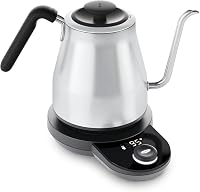
The Fellow Stagg EKG Pro suits coffee drinkers who want to control both water temperature and the pour. It pairs a 0.9 L capacity with a precision gooseneck spout, to-the-degree temperature control, and a color LCD.
Its brew timer and temperature-hold feature fit a routine where you heat water, prepare the brewer, and pour in stages. The controlled stream helps you direct water across the coffee bed instead of pouring a broad rush into one spot.
Skip it if your main job is quickly filling several mugs or adding hot water to meals. Its smaller capacity and focused pouring style make more sense for a brewing station than a shared kitchen kettle.
For similar options, see our best gooseneck electric kettles.
Smeg: a choice for shared tea breaks
The Smeg Variable Temperature Kettle 1.7L suits households making several drinks together. Its adjustable range is 122°F to 212°F, and its keep-warm function holds the selected temperature for up to 20 minutes.
That hold window is useful when people make their drinks a few minutes apart. A soft-opening lid, removable limescale filter, and rotating base support everyday filling and handling.
Choose it when batch size and retro styling both matter. Skip it if you need a gooseneck pour or settings below its minimum temperature.
For more construction-focused comparisons, see our stainless steel electric kettle guide.
Which kettle features are worth prioritizing after origin?
Prioritize the features you’ll use each day: enough capacity, a suitable spout, and the right heat settings. Styling should come after those checks.
- Tea variety: Adjustable heat helps when your tea instructions call for water below boiling.
- Pour-over coffee: A controlled spout matters alongside temperature settings.
- Several servings: Capacity saves refilling, while a hold function helps with staggered drinks.
- Cleaning access: A wide opening and removable filter make routine care easier to manage.
Check counter space with the kettle on its base, allowing room to lift it and open the lid. Leave clearance above the spout so steam doesn’t rise directly into a cabinet.
If you’re unsure how much water you need, our guide to electric kettle sizes helps you match capacity to your routine.
What should you ask about assembly and component origin?
Ask about finished-appliance manufacture first, then name any components whose origin also matters. A finished-product origin marking does not necessarily identify where every part was made.
A useful message is: “Where is model [model number] manufactured and finally assembled, and can that location vary by batch?”
If your requirement covers the heating element, electronics, or water-contact parts, add those questions separately. Decide in advance whether you need a particular assembly country or a broader component-origin answer.
An unanswered question leaves the origin unresolved. It does not prove the kettle comes from any particular country.
How should you set up and care for a new electric kettle?
Follow the model’s manual for first use and descaling, and keep the powered base dry. These 3 kettles require hand washing.
Place the base on a stable, dry counter with the cord away from the sink and counter edge. Confirm that the appliance’s voltage matches your supply before plugging it in.
Rinse the interior and complete any initial boil-and-discard steps required by the manual. Fill within the marked minimum and maximum levels, and close the lid before heating.
Heat only water unless the manual expressly allows something else. Milk, soup, and tea leaves can leave residue or foam in a kettle designed to heat water.
Let the kettle cool before cleaning, and unplug the base. Never immerse the base or electrical connections, and avoid abrasive pads that could scratch the finish.
Descale when deposits appear, using the method and dilution the manual allows. A removable limescale filter catches particles but does not remove mineral buildup from the heating surface.
Our electric kettle cleaning guide explains routine care. Dry the outside and electrical contact area before returning the kettle to its base.
Which common buying mistakes should you avoid?
Avoid using one appealing detail to answer a different question. A familiar brand, steel body, or attractive design won’t settle origin, water-contact materials, or suitability for your drinks.
The other common mistake is choosing capacity without thinking about handling. A full kettle weighs more than an empty one, so consider how much water you can comfortably lift and pour.
Don’t fill to the maximum for every single mug, and don’t go below the minimum fill mark. Heating an appropriate amount reduces leftover hot water while keeping use within the kettle’s instructions.
Which electric kettle not made in China should you choose?
For an electric kettle not made in China, make confirmed origin your first pass-or-fail check. None of these 3 models can be recommended as a confirmed origin match without that extra evidence.
If the country requirement is met, choose Aarke for mixed tea and coffee routines, Fellow for controlled pour-over brewing, or Smeg for larger batches and staggered servings. If origin remains unclear and it’s non-negotiable, keep looking.
Use our electric kettle buying guide for the final feature check before ordering.
Frequently asked questions
How can I tell where an electric kettle was made?
Check the country-of-origin marking on the kettle or its packaging, then match it to the exact model number. If the wording is unclear, ask the manufacturer to confirm the manufacturing country and whether it varies by production batch; a brand’s headquarters or design location is not proof of origin.
Are electric kettles made in Sweden?
A Swedish design claim does not confirm Swedish manufacture; Aarke describes its kettle as designed and engineered in Sweden, but that wording identifies design work rather than the factory location. To confirm a Swedish-made kettle, check the exact unit’s origin marking or ask the brand for a model-specific answer.
Does stainless steel mean a kettle was not made in China?
No, stainless steel identifies a material, not a manufacturing country. A steel kettle may also contain plastic or silicone, and those materials do not reveal its origin either; check where the finished appliance was manufactured, then ask separately about water-contact parts if their materials matter to you.
Does a brand’s country tell me where its kettle is made?
No, a company can have its headquarters in one country, design a kettle in another, and arrange manufacture elsewhere. Use the exact model number when asking about origin, and confirm the unit when it arrives; a broad statement about the brand may not cover every kettle it sells.