How Big an Electric Kettle Do You Need?
For electric kettle large and small choices, pick 0.8 L to 1 L for small batches or 1.7 L for several drinks at once. Measure your usual batch, then choose the spout and temperature controls that suit your brewing.
On this page (9 sections)
- How big should an electric kettle be?
- Is a small electric kettle enough for one or two people?
- When does a 1 L kettle make sense?
- When should you choose a large electric kettle?
- Does a large kettle take up more counter space?
- Does a larger kettle use more electricity?
- How should you set up and care for either size?
- Which mistakes make a kettle the wrong size?
- How do you choose between a large and small electric kettle?
For electric kettle large and small choices, pick 0.8 L to 1 L for small batches or 1.7 L for several drinks at once. Measure the water your routine needs, including any used to rinse a coffee filter or warm a teapot.
Capacity sets your batch size, but the spout and controls shape daily use. A coffee brewer may value a steady pour more than extra water, while a shared kitchen may need enough for everyone in one round.
How big should an electric kettle be?
Choose a capacity that covers your normal batch, rather than the biggest gathering you might host. Occasional guests can wait for a second boil; daily refills between family members soon become a nuisance.
Measure your favorite mug instead of relying on a kettle's cup count. A small teacup and a large breakfast mug need different amounts of water.
| Water needed per session | Capacity to consider | Practical fit |
|---|---|---|
| 300–600 mL | 0.8 L | One large drink or 2 smaller drinks |
| 800–1,000 mL | 1 L or larger | A larger brew or several modest servings |
| 1,200–1,500 mL | 1.7 L | Several mugs or a shared pot |
These amounts describe water going into your drinks. Add rinse water separately, and never exceed the maximum fill line to squeeze in another serving.
Large and small electric kettles: count the whole brew
Count every use of hot water before choosing a size. Two 350 mL mugs need 700 mL, so a small kettle leaves little room for rinsing a paper filter or warming brewing equipment.
If your routine regularly approaches a kettle's limit, move up a size. You can heat a smaller amount in a larger kettle as long as you meet its minimum fill requirement.
Is a small electric kettle enough for one or two people?
The Cosori Gooseneck Kettle 0.8L suits small pour-over batches and tea drinkers who want preset controls. Choose it when your measured routine fits its capacity without a refill.
Its 5 temperature presets simplify repeat drinks, while the 1-hour hold function suits a second cup later in the same session. The interior, lid, and spout use food-grade 304 stainless steel, with no plastic contact with the water.
The narrow spout makes sense when you want to place water carefully over coffee grounds. Skip this model if you usually fill a large teapot or want to pour a whole batch quickly into several mugs.
Small capacity also doesn't guarantee a short footprint. This Cosori measures 11.6 x 9 x 7.7 in, so check the space needed for its projecting spout and handle.
If you mainly brew pour-over coffee, compare this with other options in our guide to best gooseneck electric kettles. For a broader look at choices, see the electric kettle buying guide.
When does a 1 L kettle make sense?
The Bonavita 1L Gooseneck Kettle suits brewers who want finer temperature choices and a little more water than the smaller Cosori holds. Its capacity is a useful middle ground when your daily brew has outgrown a small kettle.
The Bonavita offers 6 presets and temperature adjustment in 1-degree increments from 140°F to 208°F. Its hold function lasts up to 60 minutes, giving you time to prepare a brewer before pouring.
Choose it if you follow recipes with specific water temperatures and want controlled flow. Skip it if you mainly need boiling water for shared drinks, or want a selectable temperature below its stated adjustment range.
Its construction includes 304 stainless steel and BPA-free plastic, so don't assume that a steel body means an entirely plastic-free kettle. Buyers making material contact a priority should compare the exact water-contact features.
For help deciding whether adjustable settings matter to your drinks, read about what variable temperature means on a kettle.
When should you choose a large electric kettle?
Choose a 1.7 L kettle when several people need hot water together. The Cosori Stainless Temperature Kettle and Cuisinart JK-17P1 serve that need with different control styles.
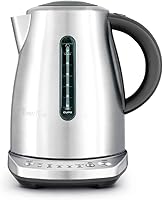
The Cosori suits a household that makes different types of tea or coffee. Its controls include settings for boiling, black tea, oolong tea, green tea, and coffee, plus temperature adjustment from 105°F to 212°F in 5°F steps.
Its all-metal interior keeps plastic out of contact with the water. Two lid-opening angles give you a smaller opening to help limit splashes and a wider opening for filling and cleaning.
Skip it if everyone simply wants boiling water and extra controls would go unused. Also skip a large kettle if lifting a full batch would be awkward for you.
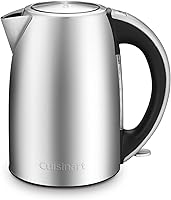
The Cuisinart suits a shared kitchen that values a simple on/off switch. Its backlit water window helps you judge the fill level, while the removable scale filter can be taken out for cleaning.
The swivel base accommodates either hand, and the handle has a nonslip grip. Cuisinart includes automatic shutoff and boil-dry protection, and backs the kettle with a limited 3-year warranty.
Skip this model if selecting a lower brewing temperature is central to your routine. Its simple boiling controls serve a different need from the adjustable models above.
For more options based on brewing needs, see best electric tea kettles. If you want to compare temperature controls, browse electric kettles with temperature control.
Does a large kettle take up more counter space?
Capacity doesn't reliably predict counter space. A long gooseneck can take up more room across the counter than a larger-capacity kettle with a regular spout.
The large Cosori measures 9.1 x 6.7 x 10.2 in, while the Cuisinart measures 8.8 x 6.1 x 9.75 in. Compare the full dimensions with your available area, including room to lift the kettle and open the lid.
Allow space for steam to escape without collecting beneath a cabinet. Place the base on a flat, dry surface near a suitable outlet, with the cord away from the counter edge.
Weight matters as well as footprint. A full 1.7 L batch adds about 1.7 kg of water to the kettle's own weight, so consider how much you'll comfortably lift and pour.
Does a larger kettle use more electricity?
Heating more water takes more energy, but owning a larger kettle doesn't mean you must fill it every time. Measure what you need while staying above its minimum fill line.
Wattage describes power draw, not the total energy needed for every batch. Water volume and starting temperature also affect heating time, so don't compare kettles by wattage alone.
Use a hold setting when you'll return for another drink soon. Leaving water hot through a long gap uses energy that a fresh batch later may avoid.
For more on power and heating, see how many watts an electric kettle needs.
How should you set up and care for either size?
Follow the kettle's first-use instructions and keep its base dry. Before heating, check the fill marks, seat the kettle correctly, and close the lid as directed.
Keep the spout pointed away from people and leave hot water room to move as you lift. Open the lid carefully after heating, since steam can escape toward your hand.
All 4 kettles here require hand washing. Unplug the base and let the kettle cool before cleaning; don't immerse electrical parts or use harsh abrasives inside.
Descale when mineral deposits appear, following the model's instructions for cleaner strength and rinsing. A removable scale filter catches particles during pouring, but it doesn't remove deposits from the kettle itself.
Our guide to descaling an electric kettle explains the care routine in more detail.
Which mistakes make a kettle the wrong size?
The main mistake is buying by maximum capacity without measuring your normal batch. Check these details before settling on either size:
- Ignoring minimum fill: A large kettle may require more water than your smallest drink needs.
- Overfilling for guests: Use another batch rather than filling above the maximum mark.
- Choosing a gooseneck for every task: Controlled flow helps pour-over coffee, but isn't necessary for filling mugs.
- Counting only drinking water: Filter rinsing and preheating can push a small kettle past its limit.
- Assuming steel means no plastic contact: Compare water-contact materials separately from exterior finish.
- Buying controls you won't use: Presets help mixed tea routines; a simple switch suits straightforward boiling.
If your main uncertainty is spout shape, read whether you need a gooseneck kettle before choosing capacity.
How do you choose between a large and small electric kettle?
Choose a small electric kettle for a measured solo brew, or a large one for shared rounds of drinks. Let your regular routine decide, then use pouring style and temperature control to narrow the choice.
Pick the small Cosori for preset brewing and careful pouring, or the Bonavita for finer temperature adjustment. Choose the large Cosori when several tea drinkers want different settings, or the Cuisinart when the household wants simple boiling.
Before ordering, measure your batch and your counter space on the same day. That quick check settles most large and small electric kettle decisions more clearly than comparing capacity alone.
For help choosing the remaining features, use our electric kettle buying guide and compare the best electric tea kettles.
Frequently asked questions
Is a 0.8 L electric kettle big enough?
A 0.8 L kettle is enough for 2 drinks using 300 mL each, but not 3 drinks of that size. Include any extra water needed to rinse a coffee filter or warm a teapot; measure your complete brewing routine before deciding that a small kettle will cover it.
Is a 1.7 L kettle too big for one person?
A 1.7 L kettle can suit one person who also fills a large teapot or serves guests. You don't need to fill it to maximum capacity each time, but you must meet its minimum fill line; check its counter fit and consider the weight of a full kettle.
What is the difference between a 1 L and 1.7 L kettle?
A 1.7 L kettle holds 700 mL more than a 1 L model, enough for 2 additional 300 mL drinks with some water left. That extra capacity helps with shared rounds of drinks; it doesn't tell you the kettle's footprint, pouring control, or available temperature settings.
Should I buy a small or large electric kettle?
Choose a small electric kettle when your normal batch fits comfortably within its capacity, or a large kettle when several people need hot water together. Check minimum fill requirements for single drinks, too; a larger model can serve both needs if it fits your counter and feels manageable to lift.