How Many Watts Does an Electric Kettle Need?
Electric kettle wattage around 1,500 W suits full-size household batches. For smaller brews, 1,000–1,200 W can work well when the capacity, temperature controls, and pouring style fit your routine.
On this page (8 sections)
- How should you choose electric kettle wattage?
- Who should choose the Cuisinart for everyday boils?
- Who should choose the Greater Goods for pour-over?
- Who should choose the Timemore for small brews?
- Does higher wattage use more electricity?
- What should you check before plugging in a kettle?
- How do you keep a kettle working well?
- Which electric kettle wattage should you choose?
Electric kettle wattage around 1,500 W is a useful starting point for full-size household batches. For smaller brews, 1,000–1,200 W can suit your routine, especially when temperature control and a careful pour matter more than filling several mugs.
Choose the amount of water you need first, then the power and controls. Buying a powerful kettle won't save much time if you fill it to the top for every single cup.
How should you choose electric kettle wattage?
Choose power that fits your usual batch, rather than treating the highest number as the best kettle. For these 3 models, the main choice is between larger everyday boils and smaller, temperature-controlled brews.
Start by measuring the water your normal recipe needs. Include water for rinsing a coffee filter or warming a brewer if you do those steps, since they count toward the kettle's usable fill.
Next, decide whether you need boiling water or a specific brewing temperature. A simple boil kettle suits hot cocoa and other tasks that need hot water, while adjustable controls make it easier to repeat a tea or coffee recipe.
For broader buying factors, see our electric kettle buying guide. If you're unsure about capacity, start with how big an electric kettle you need.
Electric kettle wattage and heating time
More watts generally means a shorter wait for the same amount of water, with the same starting and target temperatures. Watts measure the rate of electrical energy use, rather than the total energy needed for a brew.
Water volume can matter more than the power difference between 2 kettles. A small morning batch in a lower-powered model may finish before a full higher-powered kettle, so compare the amount you actually brew.
A useful comparison needs equal fill amounts. Don't judge speed by how long each model takes to heat its own maximum capacity.
The element transfers heat into the water as electricity flows through it. Our guide to how an electric kettle works explains the heating and shutoff process.
Who should choose the Cuisinart for everyday boils?
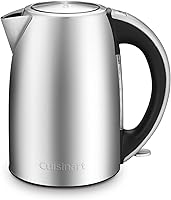
Choose the Cuisinart JK-17P1 for larger batches and simple boil operation. Its 1,500 W heater and 1.7 L capacity suit households making several drinks together or filling a French press.
The water window has level markings and a blue backlight, which helps you fill for the amount you need. The lid opens with a button, and the 360° base lets you return the kettle from either side.
A stay-cool nonslip handle, splash guard, and dripless spout support everyday pouring. Auto shutoff and boil-dry protection add safeguards, though you still need to follow the fill instructions.
The removable scale filter is useful if loose mineral flakes collect in your water. Cuisinart backs this model with a limited 3-year warranty.
Skip it if precise temperature selection is central to your brewing. Its simple on/off operation makes it a better fit for boiling water than for recipes that call for a repeatable temperature below boiling.
Who should choose the Greater Goods for pour-over?
Choose the Greater Goods for controlled coffee pours and longer brewing sessions. Its 1,200 W heater, 0.8 L capacity, and gooseneck spout offer a middle option between a large boil kettle and a smaller personal brewer.
Temperature selection runs from 104°F to 212°F, and the display shows the current water temperature. Hold Mode can maintain your setting for 10 or 60 minutes by reheating as needed.
The counterbalanced handle and narrow spout suit slow pours over a coffee bed. A built-in brew timer helps you track stages such as the bloom and the main pour without using a separate timer.
Greater Goods states that water does not touch plastic, and the interior uses 304 stainless steel. The ready tone can also be switched off if an audible alert would interrupt your morning.
Skip it for frequent large batches or quick bulk pouring. A gooseneck's controlled stream is useful for coffee, but it's a less direct fit when your main task is filling several mugs quickly.
Compare other shapes and controls in our guide to gooseneck electric kettles.
Who should choose the Timemore for small brews?
Choose the Timemore Fish Smart for small, temperature-controlled coffee batches. This home edition uses 1,000 W and has a nominal 600 ml capacity, with a maximum fill of about 560 ml.
The distinction between nominal capacity and maximum fill matters here. Plan around the usable fill, including any water you need to rinse a filter, rather than assuming the name gives your full brewing allowance.
Its temperature range is 40°C to 100°C, with a display showing both actual and target temperatures. Hold Mode reheats when the water falls below your setting, while the fine gooseneck spout supports careful pouring.
Skip it if your normal recipe needs more than the maximum fill. Splitting one brew across repeated heating cycles adds steps, and pouring above the fill limit is not a solution.
Also keep this home edition on its matching base. The home and commercial edition bases are not interchangeable.
For help choosing useful settings, read what variable temperature means on a kettle. Tea drinkers can also use our electric kettle guide for tea to match controls to their brewing routine.
Does higher wattage use more electricity?
Higher power draw does not automatically mean more energy per boil. A more powerful heater can draw electricity at a higher rate while running for less time.
Energy use is measured in kilowatt-hours:
Energy used = watts ÷ 1,000 × heating time in hours.
For example, a kettle drawing 1,500 W continuously for 4 minutes uses 0.1 kilowatt-hours. That's 1.5 kilowatts multiplied by 4/60 of an hour.
Use this as an estimate, since temperature controls may cycle the heater. Comparing wattage alone won't tell you which kettle uses less energy for your actual routine.
The clearest habit is to heat only what you need, while staying above the minimum fill. Repeatedly boiling unused water adds energy use without helping your drink.
Hold functions also use energy when they reheat water. Our guide to whether a kettle keep warm setting is worth it can help you decide if that convenience fits your day.
What should you check before plugging in a kettle?
Check electrical compatibility, counter space, and fill limits before the first use. Wattage is only one part of the setup.
Match the kettle's voltage and plug to your supply, and follow its instructions for the outlet. If you use a portable power station or another limited supply, check its continuous output and appliance requirements before choosing a kettle.
Several heating appliances running together can overload a circuit. Avoid treating a spare socket on a power strip as proof that the circuit can support another high-power appliance.
Place the base on a stable, dry surface where steam can escape without reaching an overhead cabinet. Keep the cord away from the counter edge and leave enough room to lift and replace the kettle comfortably.
Follow the first-use rinse or boil instructions, and heat only water unless the manual allows something else. Use the handle and keep your face and hands away from escaping steam.
If you're still choosing a heating method, our electric kettle vs stovetop kettle comparison covers the practical differences.
How do you keep a kettle working well?
Remove mineral buildup and keep the electrical parts dry. Scale collects as water is heated, so cleaning should follow your water conditions and the kettle's instructions.
All 3 models require hand washing. Don't immerse the base or electrical connector, and let cleaned parts dry as directed before reconnecting power.
Check inside regularly for deposits, and follow the maker's descaling method rather than scraping the interior with a sharp tool. Our guide to descaling an electric kettle explains the care routine in more detail.
Clean a removable filter according to the manual, too. Catching loose flakes at the spout does not remove deposits from the kettle itself.
Avoid 3 common mistakes: filling above the maximum line, running below the minimum, and assuming a safety shutoff makes unattended use sensible. A higher wattage doesn't compensate for poor filling or neglected care.
Which electric kettle wattage should you choose?
Choose electric kettle wattage by batch size first, brewing control second, and waiting time third. That order helps you avoid buying capacity you won't use or a small kettle that forces repeat fills.
- Choose the Cuisinart for several drinks at once and straightforward boiling.
- Choose the Greater Goods for controlled pours, a brew timer, and a choice of hold durations.
- Choose the Timemore for small personal brews that fit comfortably within its usable fill.
Before ordering, measure one normal brewing session's water needs, including rinsing water. Then use our electric kettle temperature guide to decide which temperature features you'll actually use.
Frequently asked questions
Is 1,500 watts enough for an electric kettle?
Yes, 1,500 watts is a useful choice for a full-size household kettle. It suits people who heat several cups at once and value shorter waits, though the actual heating time depends on the fill amount, starting water temperature, target temperature, and kettle design.
Does a higher-wattage kettle boil water faster?
A higher-wattage kettle generally heats the same amount of water faster under similar conditions. Compare equal water volumes and starting temperatures rather than full kettles of different sizes.
A smaller batch in a lower-powered kettle can be ready before a much larger batch in a higher-powered one.
Can I use a 1,000-watt kettle at home?
Yes, a 1,000-watt kettle can suit home use, especially for small coffee or tea batches. Match its voltage and plug to your electrical supply, and check its maximum fill against your brewing needs.
Lower power draw does not make a kettle compatible with every outlet or portable power source.
How much electricity does a 1,500-watt kettle use?
A 1,500-watt kettle drawing full power for 4 minutes uses 0.1 kilowatt-hours. Calculate energy by multiplying power in kilowatts by running time in hours.
Actual use changes with the heating cycle, water volume, and target temperature, while a hold function adds energy through later reheating.