Electric Kettle vs Stovetop Kettle: Which Is Better? (October 2026)
For electric kettle vs stovetop, choose electric for push-button heating and automatic shutoff, or stovetop to use your range without a powered base. Pick around your kitchen space, usual batch size and brewing routine.
On this page (9 sections)
- Electric kettle vs stovetop: which should you choose?
- Which kettle heats water faster?
- Which capacity suits your usual batch?
- Is a whistle or automatic shutoff better?
- Which kettle fits your kitchen setup?
- Which model is easier to fill and pour?
- How do their materials and care compare?
- What mistakes should you avoid with either kettle?
- Which one should you buy?
Choose an electric kettle for push-button heating and automatic shutoff, or a stovetop kettle to use your range. The electric kettle vs stovetop decision is mostly about where you prepare drinks and how you want heating to stop.
The All-Clad suits a kitchen routine centered on the stove. The Cuisinart fits a separate tea or coffee station where a powered base can stay ready.
Neither heating method is best for every home. Start with your available space, then consider batch size, pouring and whether you need water below boiling.

Electric kettle vs stovetop: which should you choose?
Choose the Cuisinart for frequent hot drinks away from the range; choose the All-Clad when a burner is the easiest place to heat water. An electric kettle adds a dedicated station, while a stovetop kettle uses cooking space you already have.
An electric model is useful when breakfast already fills the stove with pans. You can heat water beside your mugs without waiting for a burner to become free.
A stovetop model makes sense when counter outlets are scarce or you dislike keeping another powered appliance out. It still needs a safe place to cool and sit between uses.
Don't buy around appearance alone. Trace the trip from the tap to the heat source and then to your cup, and choose the setup with fewer awkward reaches.
Our electric kettle buying guide explains the wider range of electric designs if these two options don't match your routine.
Electric vs stovetop kettles for daily tea and coffee
Your brewing method matters more than how many drinks you name. Tea, cocoa and French press coffee can all need hot water, but they don't always need the same temperature or pouring style.
For tea, follow the brewing directions rather than assuming every leaf needs a rolling boil. Neither kettle here offers a selectable brewing temperature, so choose another model if setting a target temperature is a priority.
For a French press or cocoa, a regular pouring spout can be practical. For pour-over coffee, a narrow spout may make a slow, directed stream easier to manage.
Read whether you need a gooseneck kettle before choosing either model mainly for pour-over use. Solve the pouring requirement first, then choose the heat source.
Which kettle heats water faster?
There is no confirmed speed winner between these two kettles. The Cuisinart has 1500 watts of power, while the All-Clad relies on the heat your range delivers.
Cuisinart describes its kettle as fast heating. That doesn't give a reliable boil time for every fill level, and it doesn't guarantee a head-to-head lead over the All-Clad.
A small amount of water generally takes less time to heat than a full kettle. Starting temperature also matters, so comparisons using different amounts or different tap temperatures can mislead.
With a stovetop kettle, burner type, size and setting affect heating. Use a suitable burner and follow the kettle instructions rather than turning every burner to its highest setting.
For daily convenience, count the steps around boiling too. An electric kettle may save you a trip back to the stove even when the difference in heating time is small.
Our guide to how many watts an electric kettle needs explains power in more detail. Don't treat a wattage number as a guaranteed boiling time.
Which capacity suits your usual batch?
Choose enough capacity for your normal round of drinks, without planning to fill the kettle completely every time. The All-Clad holds 2 quarts, about 1.9 liters, while the Cuisinart holds 1.7 liters.
That gap is roughly 200 milliliters. It can matter when you are close to the smaller kettle's limit, but it isn't a large step up for serving a group.
Measure the water for your usual mugs or brewer. A large mug can hold much more than a small teacup, so a claim about the number of cups is less useful than your own batch size.
Include any water you use to warm a teapot or rinse a coffee filter. If your normal session exceeds the permitted fill, plan on another batch or choose a larger kettle.
For one mug, heat only what you need while staying above the required minimum. Filling to the top out of habit means heating extra water and carrying extra weight.
See how big an electric kettle you need if you're deciding between a personal kettle and one for shared drinks.
Is a whistle or automatic shutoff better?
Automatic shutoff suits routines with several tasks; a whistle suits someone ready to act at the stove. The key difference is that an alert asks you to stop heating, while shutoff does that step for you.
The All-Clad whistles at boiling, but the burner stays on until you turn it off. It is a poor fit if closed doors, headphones or household noise are likely to keep you from hearing it.
The Cuisinart has automatic shutoff and boil-dry protection. These features are useful during breakfast prep, but they don't make it sensible to leave home or ignore the kettle while it heats.
Boil-dry protection is a backup, not a normal way to stop a cycle. Check the water level before switching on and don't repeatedly try to heat an empty kettle.
Keep your face and hands away from the steam path. Shutoff stops heating; it doesn't make the water, spout or body cool enough to touch.
Which kettle fits your kitchen setup?
Pick the model with a safe, convenient home near your drink supplies. Check the filling route, lid clearance, pouring space and heat source before deciding which design saves room.
A kettle that fits under a cabinet may still need to be moved before opening its lid. Leave room for that movement and keep escaping steam away from cabinet undersides and nearby electronics.
Set up the All-Clad around your range
The All-Clad works on any stovetop, including induction. Choose a suitable burner or cooking zone, and keep the kettle stable and centered.
On a gas range, keep flames under the base rather than letting them climb the sides. Position the handle so you can reach it without leaning across another hot burner.
Don't assume the stainless steel handle will stay cool. Have suitable heat protection ready, turn off the burner before lifting, and use a heat-safe resting place afterward.
Skip this model if your stovetop is often crowded or difficult to reach. Its heat source should be a convenient part of your routine, not an obstacle between you and a cup of tea.
Set up the Cuisinart near an outlet
The Cuisinart needs a stable surface and access to an outlet. Place its base where the cord won't cross a walkway, hang over an edge or reach a hot burner.
The kettle measures 8.8 inches long, 6.1 inches wide and 9.75 inches high. Allow extra space to lift it off the base and open the lid.
Its 360-degree connector lets you position the handle for either hand. Cordless pouring means you can carry the kettle to your cup after heating; the base stays connected to power.
For more detail about the base and heating element, read how an electric kettle works.
Which model is easier to fill and pour?
Choose around the amount you can lift and pour steadily, not just the maximum capacity. Water adds weight, and a kettle that feels manageable empty may be awkward when full.
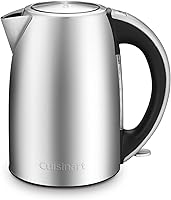
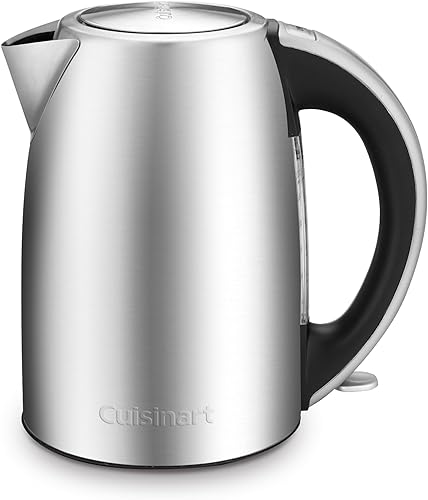
The Cuisinart has a blue backlit water window with measurement marks and an easy-open lid. Its stay-cool nonslip handle and spout with a splash guard are useful features, but you still need a slow, controlled pour.
The All-Clad has visible fill lines, a hinged spout cap and a riveted, sloped handle. Open the cap as directed before pouring and keep your free hand away from escaping steam.
Lift and pour over a clear work surface. Don't stretch across a table or hold a cup in your other hand while pouring boiling water into it.
If a full kettle feels too heavy, use smaller batches within the allowed fill range. Someone with limited grip strength should consider the handle shape and filled weight before choosing either model.
How do their materials and care compare?
Both kettles use stainless steel, but their cleaning routines differ. The Cuisinart is hand wash only; the All-Clad is dishwasher safe, though All-Clad recommends handwashing.
The All-Clad has a polished surface and a bonded base that All-Clad says helps resist warping. Gentle cleaning helps avoid scratching the finish; All-Clad backs the kettle with a limited lifetime warranty.
The Cuisinart has a stainless steel interior and exterior, a concealed heating element and a removable scale filter. Cuisinart backs it with a limited 3-year warranty.
Unplug the electric base and let the kettle cool before cleaning. Keep the base and electrical connections out of water, and follow the manual for cleaning the vessel.
Remove scale before it becomes a thick layer
Mineral deposits need descaling, even in a stainless steel kettle. A concealed element doesn't remove minerals from your water, and a spout filter doesn't stop deposits from forming inside.
Use the descaling method and cleaner permitted by the kettle's instructions. Don't mix cleaners, and rinse as directed before heating drinking water again.
Remove and clean the Cuisinart's filter according to its care instructions. A filter can catch particles, but it doesn't replace cleaning the inside of the kettle.
Our guide to descaling an electric kettle explains the process for electric models. For the stovetop kettle, follow All-Clad's care directions rather than assuming every electric-kettle method applies.
What mistakes should you avoid with either kettle?
Fill correctly, use the intended heat source and keep the kettle for heating water. Most avoidable problems begin with overfilling, unsuitable contents or treating a safety feature as permission to stop paying attention.
- Don't exceed the maximum fill line. Leave the required space for boiling water, and follow the minimum fill instructions too.
- Don't put the electric kettle on a burner. Its base is the intended heat source, even though the vessel has a metal exterior.
- Don't heat milk, soup or tea leaves in it. Prepare drinks in your cup, pot or brewer unless the kettle instructions expressly allow other contents.
- Don't open the lid over active steam. Stop heating and follow the instructions before refilling.
- Don't force a faster pour. Tip steadily and keep the spout close enough to the receiving vessel to limit splashing.
Use fresh water for the amount you plan to drink. Empty leftover water once the kettle is safe to handle, and leave it clean between uses.
Don't expect shutoff to mean the water will stay at a chosen brewing temperature. If you want temperature presets, compare electric kettles with temperature control before buying.
Which one should you buy?
For electric kettle vs stovetop, buy around your daily route from filling to pouring. Choose the All-Clad if your range is the natural place to prepare drinks; choose the Cuisinart if a separate drink station would make mornings easier.
| Product | Best for | Capacity | Material | Heat source | Our score |
|---|---|---|---|---|---|
| All-Clad 2-Quart Stovetop Tea Kettle | induction kitchens | 2 quarts | Stainless steel | Any stovetop, including induction | 7.9 |
| Cuisinart JK-17P1 Cordless Kettle | busy breakfast routines | 1.7 liters | Stainless steel | Electric base | 7.8 |
All-Clad 2-Quart Stovetop Tea Kettle
Buy the All-Clad if you want to use your existing stove and are happy to turn off the heat when it whistles. It also suits a kitchen where a powered base would compete with other counter appliances.
Skip it if hearing the whistle will be unreliable or carrying hot water from the range would be awkward. A kettle should fit the way you move through the kitchen.
Cuisinart JK-17P1 Cordless Kettle
Buy the Cuisinart if you make hot drinks often and have a clear spot near an outlet. Its lift-off design keeps the cord out of pouring, while shutoff removes the need to return to a burner switch.
Skip it if you need selectable brewing temperatures, a dedicated pour-over spout or a setup without a powered base. For the next step, use our electric kettle buying guide to match those needs to a different design.
Frequently asked questions
Is an electric kettle faster than a stovetop kettle?
There is no confirmed speed winner between these models; Cuisinart describes its electric kettle as fast heating, but a fair comparison needs the same water volume and starting temperature. The All-Clad's pace also depends on the burner, so your range affects the result.
Can you use a stovetop kettle on induction?
Yes, the All-Clad kettle works on induction as well as other stovetops; induction compatibility is specific to the kettle, so don't assume every stovetop model will work. Match the kettle to a suitable cooking zone and follow the range and kettle instructions for placement.
Does a stovetop kettle turn off automatically?
The All-Clad's whistle tells you the water is boiling, but you must turn off the burner yourself; the Cuisinart has automatic shutoff and boil-dry protection. Those features reduce manual steps, but you should still stay nearby and follow the instructions while heating water.
Which kettle holds more water?
The All-Clad holds 2 quarts, about 1.9 liters, compared with the Cuisinart's 1.7 liters; that is roughly 200 milliliters more, rather than a large jump in batch size. Measure your usual mugs or coffee brewer and stay within each kettle's permitted fill range.
Can an electric kettle be used without a base?
The Cuisinart needs its powered base to heat water, but you lift it off for cordless pouring; cordless refers to carrying the kettle, not heating without electricity. Never place an electric kettle on a stovetop or try to heat it with another source.